Tuesday, 31 August 2021

Building a Wreck - Final Update (#4)

I finished off my diorama/terrain piece of a burnt out Panzer III this weekend. Here are some more in-progress shots illustrating how I got to finished article. In the last blog, I had got to the stage where I had finished the base, undercoated and then highlighted the tank using my airbrush and then hand-painted the base colours onto the tracks.

In my last post, I had been debating over which of two techniques to follow; in the end I made up my own technique, which combined a bit of both.

After applying the base colours, the next stage was painting the burnt effect onto the tank's rear deck and turret, representing an engine fire. I used two colours for this: Vallejo Model Color USA Olive Drab 70.889 for the first coat and Black 70.950 for the top coat. 


The photo below perhaps best shows how the two colours work together. The whole burnt area was dabbed with a sponge which had been dipped in Olive Drab to create a mottled appearance. The centre of the burnt area was then lightly "over-dabbed" with another piece of sponge dipped in Black. I think that the Olive Drab looks good when representing the slightly charred effect, rather than just using black.


The next coat of paint was Vallejo Game Color Parasite Brown 72.042, which is actually not very brown, much more orange, but a really good proxy for oxidised metal. This was dabbed on using a piece of sponge.


The final base colour, which was dabbed on with a piece of sponge, was Vallejo Model Air Sand (Ivory) 71.075. This was added around the edge of the burnt area.


On the photo below, you can see a bit more modelling that I did. I had already added a deceased crew member onto the front track guard, but following some constructive feedback on the Rubicon Facebook page, I removed one of the arms and re-attached it in a slightly different position. The other arm proved a bit more difficult to manipulate due to the problems with working with hard ABS plastic, so I covered it up with some custom made tarpaulin (tissue paper painted with diluted PVA glue).

The tarpaulin looks a bit translucent in this photo because it is still wet with water and glue.


Another technique that I used was loading a flat-edged paintbrush with diluted white paint and then gently flicking the bristles to lightly spatter white spots on the edge of the burnt area.

The last stage involved using MIG pigment powders and a fixing agent over the top of the base paint layers. The pigment colours were Old Rust (P230), Light Rust (P024) and Light Dust (P027)

Anyway, I think I am calling this finished now, other than to apply some flock and static grass to the base.


If you have any questions about any part of this project, post a question in the Comments section below.

My next (or next but one) project will be a damaged horse-drawn supply wagon with the dead horses and several casualty figures.

Monday, 30 August 2021

Building a Wreck - Update #3

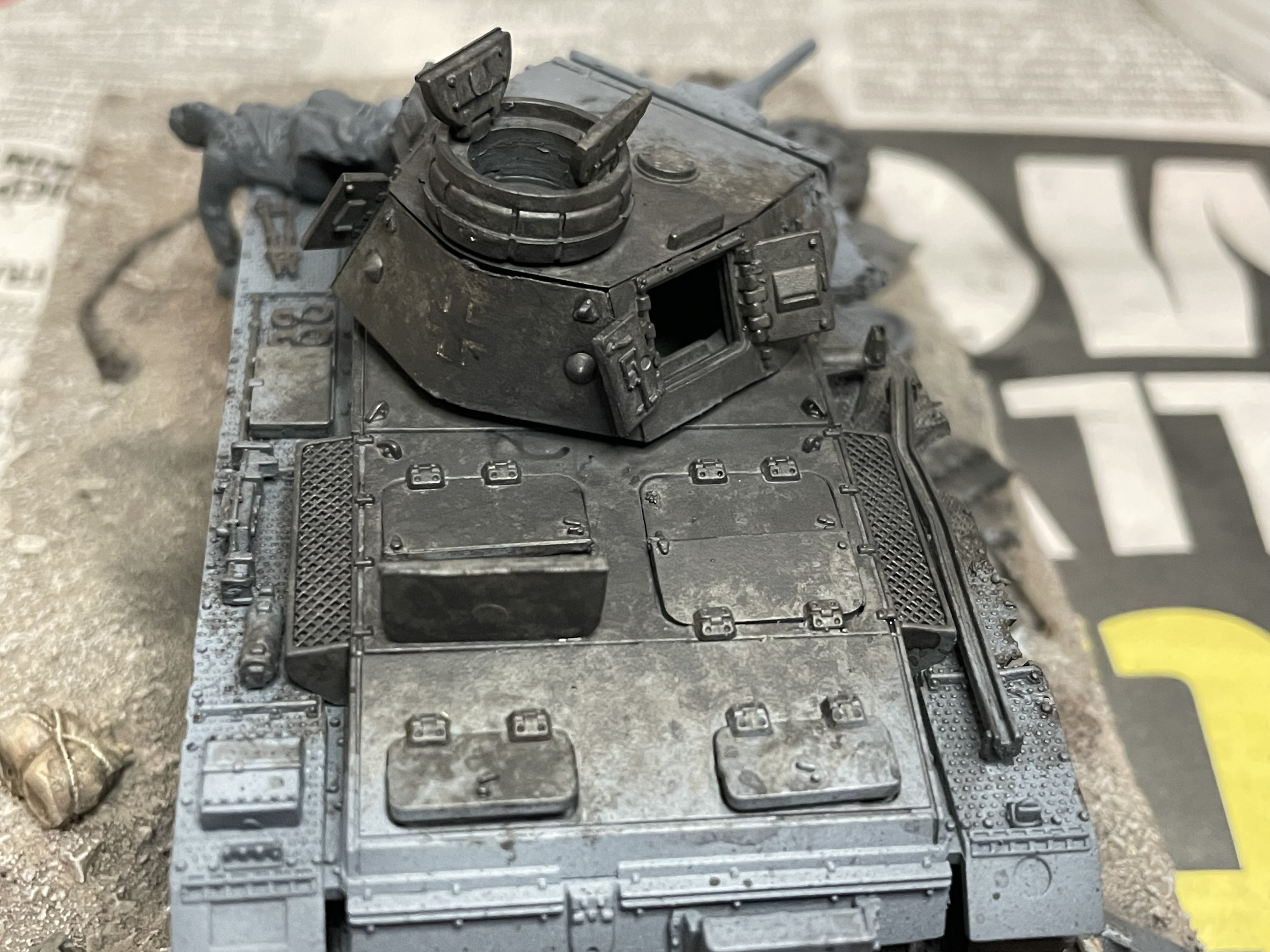
Here are a few in-progress photos of the main model. I've finished the turret here and modelled it with all the hatches open, which seems to be a common feature in photos showing blown-up tanks.


I have glued the turret in place so that I can lift up one side to be a little bit higher, giving the impression when viewed from the opposite side of the more damaged side having collapsed. Snipping off the suspension arms and gluing the three remaining roadwheels higher up the hull also gives the impression of the vehicle having collapsed on one side, which also seems to be another feature from contemporary photos.

A few shots of the tank placed in position on the base. The non-collapsed side of the base was built up a little, maybe only by 5mm, but it adds to the optical illusion of the damaged side sagging.


The model has now had a coat of Halfords grey car primer.


The sagging effect is perfectly depicted in this photo:


I used Vallejo Model Air Panzer Dark Grey 71.056 to give the tank a dark base coat and let it dry. I also sprayed a little onto the base to represent scorching of the ground (the tank is going to be partially burnt out).

The next colour was Dark Grey Blue 71.054, which was applied to most of the upper facing panels, followed by a light highlight of Medium Gunship Grey 71.097 on some of the panel edges and raised areas. Following on what I learned when painting my platoon of Rubicon panzers, I have chosen to slightly overdo the highlighting; once the other effects are applied, the stark highlights become toned down, so being too subtle at this stage is just wasted effort.


I've also hand-painted the tracks and super-glued the tank onto the base. I was worried that I kept catching the delicate piece of towing cable that was attached to the front of the tank and that it was going to break. The bit that was attached to the tank lines up with the larger piece of towing cable that is glued onto the base.  The other delicate piece on the front, that was just waiting to accidentally snapped off, was the bar which was holding the extra track onto the glacis plate. I had made that out of a thin strip of plastic and bent it a bit before attaching to the tank.


The next stage will be to apply the decals, then set the whole thing on fire! However...I can't decide on which technique to use for the burnt effects: either the Vallejo chipping effect or Andy's Hobby Headquarters sponge method.

Next update in this series is here.

Sunday, 29 August 2021

Building a wreck - Update #2

I've been making some progress this weekend on almost finishing the base off; I will add some vegetation to it once the tank model has been finished and attached to the base, so that I can put track marks in the right place.

I have also found a great video from Vallejo on Youtube, which demonstrates exactly what I want to achieve. There are quite a few videos and tutorials out there, but this is my favourite so far: How to burn out effects on tanks - YouTube  It is also within my capabilities (I think!)

Here are some in-progress shots. I cut a small piece of 3mm MDF for the base and sanded the edges to create a chamfered edge, so that it blends with the gaming table as much as possible. I really detest bases on vehicles, especially 1/56 scale, but because I want to add debris, then a base is a must. 

I layered on some wall filler to create a bit of texture and then sprinkled sand and fine grit onto it. Once dry, I sprayed it with diluted PVA to bind it all together and then, once dry again, sprayed it with grey car body primer from Halfords (my go-to primer for everything). The tank was also primed at the same time.

I chopped up several bits of the model when assembling it to create the debris, plus some selected parts from the sprue, plus a few odds and ends I had in my bits box, such as jerry cans.

After the primer had dried on the base, I super-glued some wreckage and debris onto it and then gave the whole thing a first coat of a pale-ish brown paint (cheap tester pot from B&Q). Once the base coat had dried, I created a wash using a dark chocolate brown paint and dabbed that randomly to create some depth to the colour.  Once that had dried, I lightly dry-brushed a pale cream colour on and picked out some of the larger rocks.

I painted most of the debris in the same colour that the tank will be painted: a dark panzer grey, then gave it a light dry-brush with a pale sand colour to highlight some of the detail. I then used Agrax Earthshade from Citadel to darken the recesses on some of the debris.

Finally, I got out my airbrush and sprayed some dark panzer grey paint in the place where the fire from the tank would have scorched the earth.

The final step for today was to give the whole tank a spray with Vallejo Model Air Panzer Dark Grey 71.056. I'm going to leave that base coat for at least several hours to cure before I start with the next layer of paint.


I'll post up some step-by-step progress shots of the tank model soon.

Latest update here.

Friday, 27 August 2021

Building a wreck - Update

I've now made a start on assembling a Rubicon Panzer III (H1 variant) as per my last post and also made a start on destroying it as I go.  It's been sort of fun to imagine how this unfortunate Panzer met its end.

Here are a few in-progress shots. Most of the hull is just the standard, out-of-the-box build, though I have started to cut up the track guards on one side that is going to have most of the battle damage. I have also made a few minor changes such as positioning some of the hatches as if they had blown open as a result of the explosion.  It's a shame that the driver's hatch is moulded as a single piece, though I may retro-fit some other hatches over the top (if I can figure how to do it).


One of the most obvious bits of damage to knocked out tanks is to the tracks. It was surprisingly easy to cut the roadwheels off the tracks. I had been reading up about the melting point of ABS plastic and thinking about how to safely damage the kit without either burning myself or inhaling noxious fumes. A little bit of work with a scalpel and side cutters was all it needed. The hard ABS plastic does not lend itself well to too much customisation, but because I am seeking to damage the vehicle anyway, a little bit of actual damage to the kit does not matter quite so much.


The most fun part so far has been chopping up the track links and repositioning them into what you see below. The middle and central return rollers were moved leftwards by one position, which allowed me to bend the intervening track; the left-most return roller was then positioned (with all the track removed from it) in the right-most position and glued on at an angle.  The other parts of the track were attached as a separate pieces, though it is difficult to tell that they don't actually all join up any more.

The three remaining roadwheels are not attached to the bogeys, which were cut off, but glued on higher up the hull to represent the suspension having sagged.

More to come soon.

Latest update here.

Wednesday, 25 August 2021

Back to the hobby...building a wreck

Due to the abatement of the Covid lockdown rules, I've had a few months away from the hobby and been getting outdoors as much as possible, visiting friends and family, going out for meals, having one or two games of Iron Cross and generally trying to make the most of "real life".

However, after a bit of a break, I've decided to come back with a bit of tank modelling. I have fancied creating a burnt-out tank as a terrain piece for a while now, so thought that I would give that a crack. It also coincides with getting my 12 year interested in putting together models; he built his first kit last week (a Revell Star Wars Star Destroyer) and is now itching to make more, so I feel like I have accomplished something already.

I purchased a platoon of Panzers from Rubicon earlier this year and built an army for Iron Cross around them, so thought that I would create a wrecked Panzer III to place on the same gaming table. I think that I might also add a load of German casualty figures from Great Escape Games, some dead horses and a wrecked horse-drawn wagon to a series of diorama/terrain pieces.

I've started with a new Rubicon Panzer III kit and intend to assemble it in a part-destroyed state, but then paint it as a burnt-out wreck.

This is the sort of effect that I intend to replicate:


I'll post up some photos of the work-in-progress as I go.

Update 27th August: I've posted up some WIP progress shots up.

Sunday, 23 May 2021

AAR - Operation Barbarossa

After many months of not being able to game, Stuart and I managed to get in a big game of Iron Cross a couple of weeks ago; I have only just got around to writing it up because I've been spending lots of time out of the house making the most of not being in lockdown. All the miniatures and vehicles that I have been painting during lockdown got a good run-out onto the table. Here's a mostly pictorial after action report from the game we played, which was loosely set during the German invasion of the Soviet Union (Operation Barbarossa) in June 1941.

I had about 780 points of a German panzer division versus Stuart's Russians. He was defending a village, so started the game with all units dug in and hidden with approximately 350 points. We were trying out a new rule for units in ambush positions too, which seemed to work well, other than my tanks being on the receiving end - see the photos below for the full visual impact!  

Stuart has moved to new premises and has the space to set up some permanent (large!) gaming tables. The table we were playing on was 18 feet in length by 6 feet wide; the fully motorised Germans had to attack from one table edge and advance rapidly up the length of the table with the objective of securing three key buildings, which was the victory condition we agreed beforehand. The vehicles are mostly from Rubicon, with a few Warlord models, the buildings and trees are all from 4Ground and the miniatures are mostly from Great Escape Games.

My German force was constituted of the following armoured units:

  • 3 x Panzer (35)t
  • 6 x Panzer III including a sub-commander
  • 2 x Panzer IV
  • 2 x Panther
And some lorry transported infantry and support units:
  • 1 x HQ
  • 1 x heavy machine gun
  • 1 x mortar
  • 5 x infantry platoons

I'm not entirely sure what Stuart had on the table because (spoiler alert) he destroyed my force before I could expose much of it. He definitely had some T34s, a couple of AT guns and a couple of units of infantry. In hindsight, I would have benefited from some lighter recce units to scout ahead and locate his units, especially the dug-in/hidden tanks and anti-tank guns.  These hidden units, combined with the new ambush rule, made mincemeat of my tanks at long range. It was still lots of fun though!

This first photo shows the German panzers blindly advancing.

This shot is taken from the German deployment zone down the length of the table towards the Russian held village in the distance.

At the bottom of this photo, you can see the Panthers advancing along the road protecting the lorry-borne units. So far, there has been no sign of the Russians.

As the Germans reach the outskirts of the farm, the infantry round the corner and come face-to-face with a well-camouflaged T34...

...which immediately puts a round straight into the lorry causing heavy casualties.

At the same time, the Russian infantry open up from the cover of a wall.

Now that the action has started, more Russian units a bit further to the rear start to move up in support of their comrades on the front line.

One of the German infantry platoons rallies, along with some fire support from the Panther, and causes the Russians to fall back. The other German unit, heavily wounded, falls back into the safety of the woods (at the top of the picture).

Following the early action around the farmhouse, the main panzer force creeps inexorably toward the waiting enemy. A well dug-in T34 fires off a shot at the rearmost Panther on the road, but misses. The Panzer Ace in the Panther returns fire and punishes the Russians for their poor gunnery.

The number of casualties per side is slightly in the Russians favour at this point, but the menacing clanking of tracks, the look on the Commissars face is definitely one of worry!

The T34 in the open field behind the farmhouse is also destroyed by the Panther's big gun, though the (red) tide is about to turn.

Seeing the oily smoke in the distance, the German medium and light tanks push forwards quickly sensing a quick victory.

Great Escape Games makes some great casualty figures, which look great when strewn around destroyed tanks.

The German panzers push forward in haste, but now lose the cover that they had, which was obscuring the Russian's line of sight. The Panzer III at the junction is about to come to sticky end at the hands of Russian infantry with Molotov cocktails.

The second lorry full of infantry rushes forward and disembarks straight into vicious combat with the group of Soviets who had just assaulted the Panzer III.

The main Panzer force on the left flank is now bogged down in fighting against a couple of T34s, so the Panthers attempt to turn the Russian flank and push forward into the open field behind the farm buildings...straight into the sights of an anti-tank gun in ambush position.

Meanwhile on the German left flank, a pair of T34s in good positions make very short work of several Panzer IIIs and 35t's. Pretty soon the assault grinds to a halt amid dense clouds of black, oily smoke.

In a last ditch attempt to encircle the Soviet line, the Panther (at the top of the photo) drives over the top of the AT gun and fires into the rear of the T34. Unfortunately, it is too little, too late: the Germans have reached their break point and fall back.

I think that we played about 7 or 8 turns, but for most of that time the Germans were being ground down in a war of attrition with some well-placed Russian units, rather than continuing to advance. The new ambush rule that we played gave the outnumbered defender a new tactic, which made the placement of units, with overlapping fields of fire really effective in defending.

The ambush rule, for any other Iron Cross players who want to try it out, is:

  • A unit which starts the game in a hidden position may declare, as long as it has not moved at all, that it is going to fire from an ambush position. None of the opposing player's units may interrupt an ambush. As soon as the ambushing unit has fired then it is revealed. An ambushing unit, which does not have the initiative, may attempt to interrupt the active player, but is revealed whether the interrupt attempt succeeds or fails.

After reading a lot of books about the Eastern Front during lockdown, it made me realise that the Russians were very successful in camouflaging their positions and setting ambushes against the advancing Axis forces. Even in the featureless steppe, which is ostensibly open and giving no obvious cover i.e. an open field, they were able to successfully dig in and launch an ambush. This translates to the gaming table too using the rule described above; even if a hidden token is placed in the middle of open terrain, then it can start the game as being hidden and use this rule.

Lesson for countering this: take some fast-moving recce units. Next game I will dig out my motorcycle infantry and a couple of SdKfz 222's to screen ahead of the main force.

Nuenen House #3 Finished?

I thought that I had finished this first house in my Band of Brothers project, but after looking at it on my painting table for the last few...